Bringing their website up to the level of their inbound strategy
- 2 weeksfor a first sprint focused on the homepage and meeting bookings
- 1 hrto create a new page, instead of a full day
- 15+optimization opportunities identified, then prioritized during the audit
(Context) Feedier
Feedier is a customer intelligence platform that centralizes and unifies the voice of the customer for mid-sized companies, subsidiaries and large groups.
Complex organizations, drowning in customer data they don’t have the resources to make use of. Feedier helps them turn that data into actionable insights to improve their customer experience.
“We worked with Damien to bring our website up to the level of our inbound strategy. We were driving traffic (LinkedIn, trade shows, podcast, influencers) to a site we knew wasn’t aligned with where we were.”
 Florian MaretteMarketing Manager @Feedier
(01)Problem
The starting point
In 2026, the marketing team decided to accelerate its inbound strategy (LinkedIn, trade shows, podcast, influencers). Except you don’t drive traffic to a site you know is poorly optimized.
The 3 issues identified during our first call:
- 01
A gap between the website and where Feedier actually stood.
The team was gaining visibility on LinkedIn, at trade shows and through a CX influencer, and the product team had a precise vision of its target. But the site wasn’t aligned with that vision: copy that was too vague, not enough social proof.
- 02
A website the marketing team could hardly evolve.
Rebuilt in one go with an agency, then frozen for a year. Changing a line of copy was fine, touching a component wasn’t: you had to understand the agency’s structure, go back to them, and pay again for something that seemed simple.
- 03
A conversion rate below target.
Since the migration from WordPress to Webflow a year earlier, conversion on the demo page had dropped significantly.
So they brought me in to fix these issues and get the site ready for inbound.
(02)Method
What we put in place
To improve a website, you have to work in iterations: it’s the only way to move fast while creating value quickly. I call it the BALL loop.
- 01BetForm hypotheses
- 02ActPut them in place
- 03LearnMeasure
- 04LoopStart again
At Feedier, we kicked off a first 2-week sprint to activate this loop, focused on the homepage and meeting bookings, and to put back a clear structure that lets them improve the ROI of their marketing on the site.
Step 1: Auditing to turn a frozen website into hypotheses to test
I audited the site to understand where visitors were dropping off, and more than 15 optimization opportunities came up: homepage, blog, social proof, navigation, forms.
15 opportunities is too many for one sprint. So we prioritized them with an ICE matrix to keep only the 3 levers with the best effort-to-impact ratio, aligned with their goals: book more demos, align the messaging, simplify site management.
- 01
The homepage
The most visited page
Clarify the message, present the benefit of each feature, add social proof, address objections. The goal: turn the traffic generated by the inbound strategy (LinkedIn, trade shows, podcast) into booked demos.
- 02
The “book a demo” page
The only action that matters
Put the focus back on “schedule a call,” which means removing the navigation, fixing the form, adding social proof and making clear what visitors get by scheduling a call.
- 03
A page template
A system to build fast
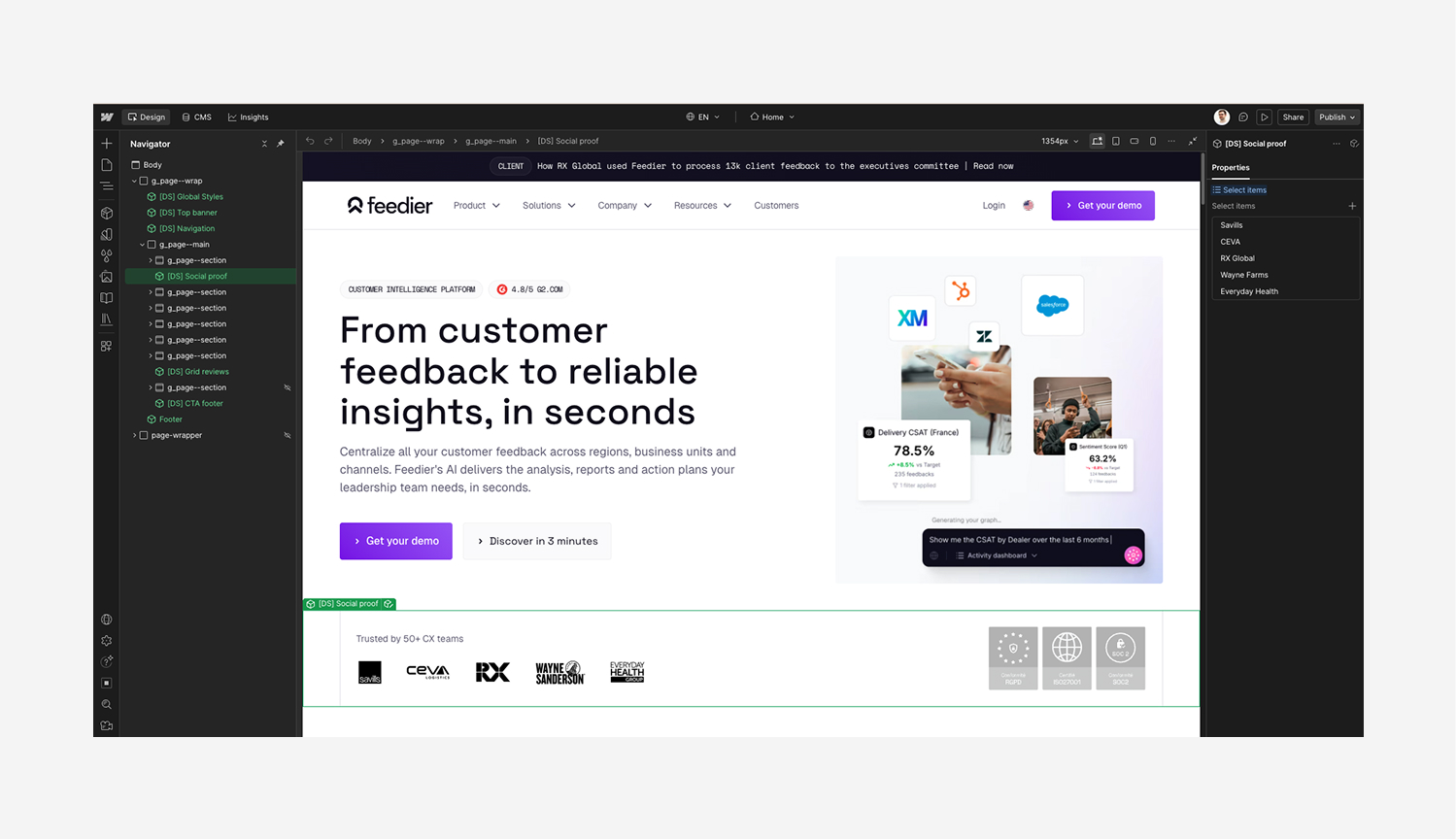
There was no real system that let the team create new pages from existing components. Data was hardcoded in many places and didn’t take advantage of the power of the Webflow CMS (FAQ, customer reviews, logos).
“His audit was clear about the priorities (homepage, demo page and site structure) so we wouldn’t have to go through an agency for every change. It was fast and we knew exactly what would be delivered.”
Florian MaretteMarketing Manager @Feedier- 01
Step 2: Designing, laying down a clean design system, building
An audit sitting in a Notion page or a Google Sheet has zero impact. So we went straight to execution, first creating the new pages in Figma based on the hypotheses from the audit.
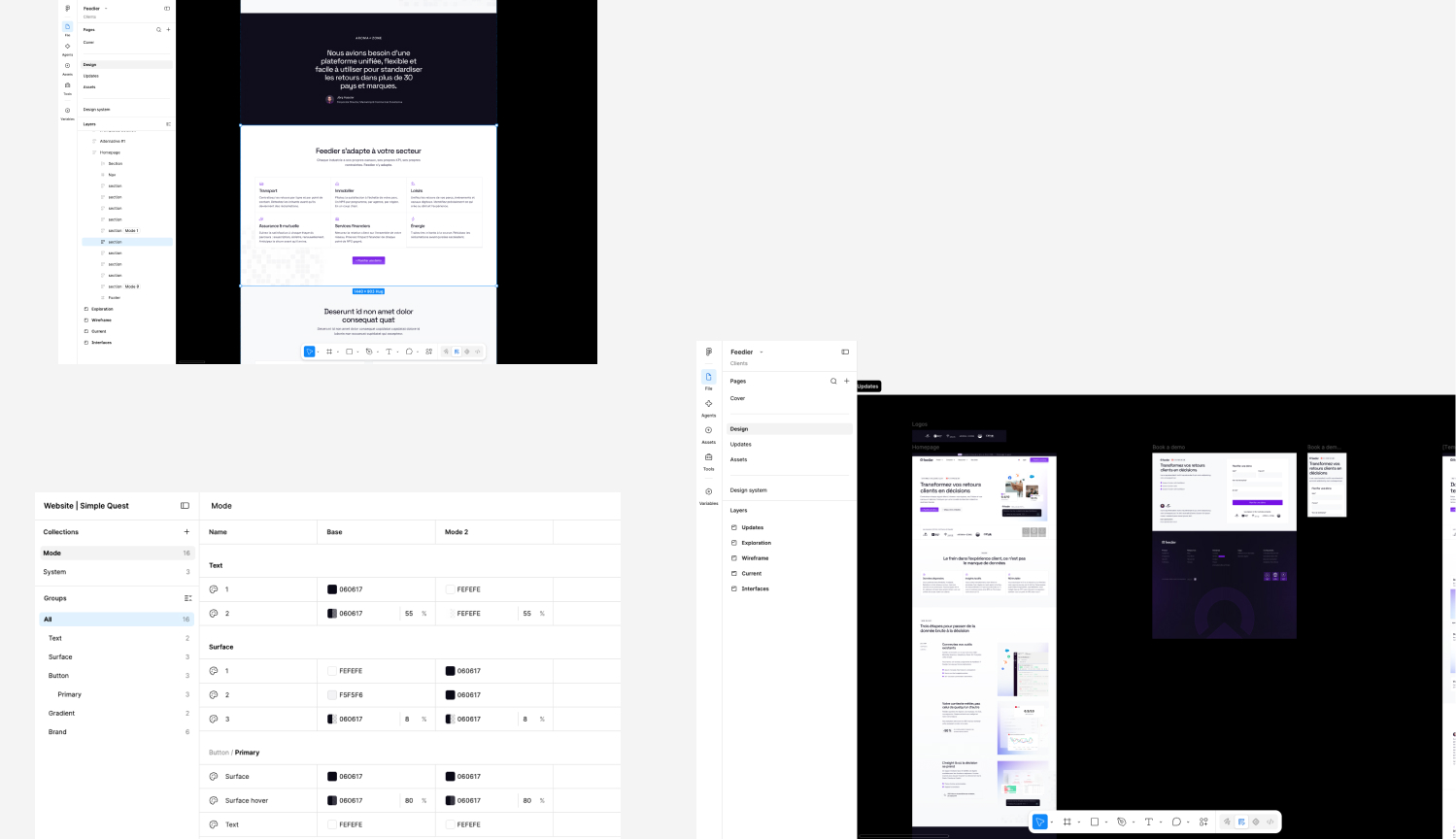
Pages and variables in Figma Rather than reusing the existing design system, which couldn’t produce a page quickly and used only a fraction of Webflow, I built a new one, starting from Feedier’s current brand and design to avoid any visual gap with the existing pages.
In practice:
- 01
components ready to assemble to create new pages in 1 hour;
- 02
color variables to switch a section between dark and light with a single class;
- 03
logos, customer reviews and FAQ managed through the CMS: content entered in one place, consistent everywhere, and structured, which matters all the more in the age of AI.
The goal: start again on a healthy foundation, centralize the data and let the team create pages without breaking anything.
“We can create pages on our own now. I put together a page in 1 hour with the template he built, when before it would have taken us a day.”
Florian MaretteMarketing Manager @Feedier- 01
Step 3: Making the team self-sufficient so it can restart the loop on its own
In a one-hour call, I trained Florian on the system: structure, CMS, template. The goal: for him to be able to edit content (copy, images, CMS) and above all create new pages from existing components, without depending on anyone.
My aim wasn’t to make myself indispensable. Without this step, the BALL loop doesn’t turn: if the team doesn’t keep the site alive regularly, the impact of its marketing plateaus.
(03)Results
What it changed
- 01
A reworked homepage and demo page to book more calls.
Based on the hypotheses set and validated with Florian during the audit.
- 02
A team that ships a page on its own in 1 hour instead of a day.
Florian rolled out the “voice of the customer” and “customer intelligence” pages without going through anyone. A sign that the team has taken back control.
- 03
A clean Webflow foundation, built to iterate again.
A design system linked to Figma, structured CMS collections, a page template: everything needed to keep making changes without rebuilding everything.
- 04
A website aligned with the vision and the goals.
A clearer message for a complex product, consistent with what is projected across the different channels (LinkedIn, trade shows, podcast).
- 05
A roadmap of hypotheses and a renewed mindset.
The remaining opportunities from the audit give a clear list to tackle one by one, and the sprint gave the team the drive to get hands-on with the site again.
The goal wasn’t to make the conversion rate skyrocket in two weeks. Everyone knew that from the start.
It was rather to put the BALL loop (Bet, Act, Learn, Loop) back in place, the loop that lets a marketing team continuously improve the ROI of its marketing on the site.
“Damien isn’t a designer/dev, he’s a CRO consultant who knows how to execute fast!”
Florian MaretteMarketing Manager @Feedier